Singular:
one
|
someone
|
anyone
|
no one
|
everyone
|
each
|
somebody
|
anybody
|
nobody
|
everybody
|
(n)either
|
something
|
anything
|
nothing
|
everything
|
Examples:
|
Somebody is coming to dinner.
|
Neither of us believes a word Harry says.
|

Examples:
|
Both are expected at the airport at the same time.
|
Several have suggested canceling the meeting.
|

Examples:
|
Some of the dirt has become a permanent part of the rug.
|
Some of the trees have been weakened by the storm.
|
Examples:
|
The accident is nobody’s fault.
|
How will the roadwork affect one's daily commute?
|
one, each, either, neither, some, any, one, all, both, few, several, many, most
Note the differences:
|
Each person has a chance.
|
(Each is a determiner describing person.)
|
Each has a chance.
|
(Each is an indefinite pronoun replacing a noun.)
|
Both lawyers pled their cases well.
|
(Both is a determiner describing lawyers.)
|
Both were in the room.
|
(Both is an indefinite pronoun replacing a noun.)
|

Interrogative pronouns produce information questions that require more than a “yes” or “no” answer.
Examples:
| ||||||||||||||||||||||||||||||||||||||||||
What do you want?
| ||||||||||||||||||||||||||||||||||||||||||
Who is there?
There are four main interrogative pronouns: who, whom, what, which Notice that the possessive pronoun whose can also be an interrogative pronoun (an interrogative possessive pronoun).
Notice that whom is the correct form when the pronoun is the object of the verb, as in "Whom did you see?" ("I saw John.") However, in normal, spoken English we rarely use whom. Most native speakers would say (or even write): "Who did you see?"
Look at these example questions. In the sample answers, the noun phrase that the interrogative pronoun represents is shown in bold.
| ||||||||||||||||||||||||||||||||||||||||||
A relative pronoun is a pronoun that introduces a relative clause. It is called a "relative" pronoun because it "relates" to the word that its relative clause modifies. Here is an example:
- The person who phoned me last night is my teacher.
In the above example, "who":
- relates to "The person", which "who phoned me last night" modifies
- introduces the relative clause "who phoned me last night"
There are five basic relative pronouns: who, whom, whose, which, that*
Who (subject) and whom (object) are generally only for people. Whose is for possession. Which is for things. That can be used for things and people only in defining relative clauses (clauses that are essential to the sentence and do not simply add extra information).**
Relative pronouns can refer to singular or plural, and there is no difference between male and female.
Look at these examples showing defining and non-defining relative clauses:
| example sentences S=subject, O=object, P=possessive | notes | ||
|---|---|---|---|
| defining relative clauses | S | - The person who phoned me last night is my teacher. - The person that phoned me last night is my teacher. | "that" is preferable |
| - The car which hit me was yellow. - The car that hit me was yellow. | "that" is preferable | ||
| O | - The person whom I phoned last night is my teacher. - The people who I phoned last night are my teachers. - The person that I phoned last night is my teacher. - The person I phoned last night is my teacher. | "whom" is correct but formal relative pronoun is optional | |
| - The car which I drive is old. - The car that I drive is old. - The car I drive is old. | "that" is preferable to "which" relative pronoun is optional | ||
| P | - The student whose phone just rang should stand up. - Students whose parents are wealthy pay extra. | ||
| - The police are looking for the car whose driver was masked. - The police are looking for the car of which the driver was masked. | "whose" can be used with things "of which" is also possible | ||
| non-defining relative clauses | S | - Mrs Pratt, who is very kind, is my teacher. | |
| - The car, which was a taxi, exploded. - The cars, which were taxis, exploded. | |||
| O | - Mrs Pratt, whom I like very much, is my teacher. - Mrs Pratt, who I like very much, is my teacher. | "whom" is correct but formal "who" is common in spoken English and informal written English | |
| - The car, which I was driving at the time, suddenly caught fire. | |||
| P | - My brother, whose phone you just heard, is a doctor. | ||
| - The car, whose driver jumped out just before the accident, was completely destroyed. - The car, the driver of whichjumped out just before the accident, was completely destroyed. | "whose" can be used with things "of which" is also possible | ||
*Not all grammar sources count "that" as a relative pronoun.
**Some people claim that we should not use "that" for people but must use "who/whom". There is no good reason for such a claim; there is a long history of "that" for people in defining relative clauses from Chaucer, Shakespeare and the Authorized Version of The Bible to Fowler's and Churchill.
**Some people claim that we should not use "that" for people but must use "who/whom". There is no good reason for such a claim; there is a long history of "that" for people in defining relative clauses from Chaucer, Shakespeare and the Authorized Version of The Bible to Fowler's and Churchill.

Relative pronouns introduce relative (adjectival) clauses.
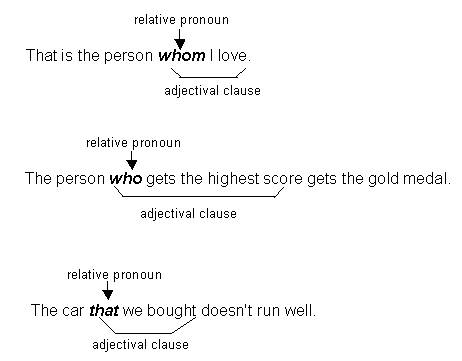
| Note: | Use who, whom, and whose to refer to people. |
Use that and which to refer to things.
|

No hay comentarios.:
Publicar un comentario