Pronouns are small words that take the place of a noun. Pronouns are words like: he, you, ours, themselves, some, each... We can use a pronoun instead of a noun. If we didn't have pronouns, we would have to repeat a whole lot of nouns.
What is a Pronoun?
Understand the difference between a pronoun and a noun.
Both are expected at the airport at the same time.
Several have suggested canceling the meeting.
Singular with non-countables / Plural with countables:
Examples:
Some of the dirt has become a permanent part of the rug.
Someof the trees have been weakened by the storm.
Indefinite pronouns use apostrophes to indicate possessive case.
Examples:
The accident is nobody’s fault.
How will the roadwork affect one's daily commute?
Some indefinite pronouns may also be used as determiners.
one, each, either, neither, some, any, one, all, both, few, several, many, most
Note the differences:
Each person has a chance.
(Each is a determiner describingperson.)
Each has a chance.
(Each is an indefinite pronoun replacing a noun.)
Both lawyers pled their cases well.
(Both is a determiner describing lawyers.)
Both were in the room.
(Bothis an indefinite pronoun replacing a noun.)
E. Interrogative Pronouns: Interrogative pronouns produce information questions that require more than a “yes” or “no” answer.
Examples:
What do you want?
Who is there?
We use interrogative pronouns to ask questions. The interrogative pronoun represents the thing that we don't know (what we are asking the question about). There are four main interrogative pronouns: who, whom, what, which Notice that the possessive pronoun whose can also be an interrogative pronoun (an interrogative possessive pronoun).
subject
object
person
who
whom
thing
what
person/ thing
which
person
whose
Notice that whom is the correct form when the pronoun is the object of the verb, as in "Whom did you see?" ("I saw John.") However, in normal, spoken English we rarely use whom. Most native speakers would say (or even write): "Who did you see?"
Look at these example questions. In the sample answers, the noun phrase that the interrogative pronoun represents is shown in bold.
question
answer
Who told you?
John told me.
subject
Whom did you tell?
I told Mary.
object
What's happened?
An accident's happened.
subject
What do you want?
I want coffee.
object
Which came first?
The Porsche 911 came first.
subject
Which will the doctor see first?
The doctor will see the patient in blue first.
object
There's one car missing. Whosehasn't arrived?
John's (car) hasn't arrived.
subject
We've found everyone's keys. Whose did you find?
I found John's (keys).
object
Note that we sometimes use the suffix "-ever" to make compounds from some of these pronouns (mainly whoever, whatever, whichever). When we add "-ever", we use it for emphasis, often to show confusion or surprise. Look at these examples:
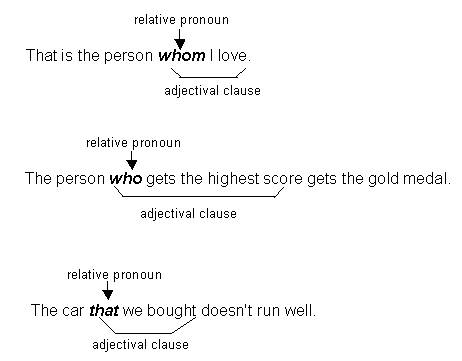
A relative pronoun is a pronoun that introduces a relative clause. It is called a "relative" pronoun because it "relates" to the word that its relative clause modifies. Here is an example:
The person who phoned me last night is my teacher.
In the above example, "who":
relates to "The person", which "who phoned me last night" modifies
introduces the relative clause "who phoned me last night"
There are five basic relative pronouns: who, whom, whose, which, that*
Who (subject) and whom (object) are generally only for people. Whose is for possession. Which is for things. That can be used for things and people only in defining relative clauses (clauses that are essential to the sentence and do not simply add extra information).**
Relative pronouns can refer to singular or plural, and there is no difference between male and female.
Look at these examples showing defining and non-defining relative clauses:
example sentences
S=subject, O=object, P=possessive
notes
defining relative clauses
S
- The person who phoned me last night is my teacher. - The person that phoned me last night is my teacher.
"that" is preferable
- The car which hit me was yellow. - The car that hit me was yellow.
"that" is preferable
O
- The person whom I phoned last night is my teacher. - The people who I phoned last night are my teachers. - The person that I phoned last night is my teacher. - The person I phoned last night is my teacher.
"whom" is correct but formal
relative pronoun is optional
- The car which I drive is old. - The car that I drive is old. - The car I drive is old.
"that" is preferable to "which"
relative pronoun is optional
P
- The student whose phone just rang should stand up. - Students whose parents are wealthy pay extra.
- The police are looking for the car whose driver was masked. - The police are looking for the car of which the driver was masked.
"whose" can be used with things
"of which" is also possible
non-defining relative clauses
S
- Mrs Pratt, who is very kind, is my teacher.
- The car, which was a taxi, exploded. - The cars, which were taxis, exploded.
O
- Mrs Pratt, whom I like very much, is my teacher. - Mrs Pratt, who I like very much, is my teacher.
"whom" is correct but formal
"who" is common in spoken English and informal written English
- The car, which I was driving at the time, suddenly caught fire.
P
- My brother, whose phone you just heard, is a doctor.
- The car, whose driver jumped out just before the accident, was completely destroyed. - The car, the driver of whichjumped out just before the accident, was completely destroyed.
"whose" can be used with things
"of which" is also possible
*Not all grammar sources count "that" as a relative pronoun. **Some people claim that we should not use "that" for people but must use "who/whom". There is no good reason for such a claim; there is a long history of "that" for people in defining relative clauses from Chaucer, Shakespeare and the Authorized Version of The Bible to Fowler's and Churchill.
Demonstrative pronouns can also be used as determiners.
Example:
Hand me that hammer. (that describes the noun hammer)
Demonstrative pronouns can also be used as qualifiers:
Example:
She wanted that much money? (that describes the adjective much)demonstrate(verb): to show; to indicate; to point to
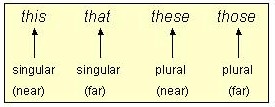
A demonstrative pronoun represents a thing or things:
near in distance or time (this, these)
far in distance or time (that, those)
near •
far ⇒
singular ☺
this
that
plural ☺☺☺
these
those
Here are some examples with demonstrative pronouns, followed by an illustration:
This tastes good.
Have you seen this?
These are bad times.
Do you like these?
That is beautiful.
Look at that!
Those were the days!
Can you see those?
This is heavier than that.
These are bigger than those.
Do not confuse demonstrative pronouns with demonstrative adjectives. They are identical, but a demonstrative pronoun stands alone, while a demonstrative adjective qualifies a noun.
That smells. (demonstrative pronoun)
That book is good. (demonstrative adjective + noun)
Normally we use demonstrative pronouns for things only. But we can use them for people when the person is identified. Look at these examples:
reflexive (adj.) [grammar]: reflecting back on the subject, like a mirror
We use a reflexive pronoun when we want to refer back to the subject of the sentence or clause. Reflexive pronouns end in "-self" (singular) or "-selves" (plural).
There are eight reflexive pronouns:
reflexive pronoun
singular
myself yourself himself, herself, itself
plural
ourselves yourselves themselves
Look at these examples:
non-reflexive the underlined words are NOT the same person/thing
REFLEXIVE pronouns the underlined words are the SAME person/thing
John saw me.
I saw myself in the mirror.
Why does he blame you?
Why do you blame yourself?
David sent him a copy.
John sent himself a copy.
David sent her a copy.
Mary sent herself a copy.
My dog hurt the cat.
My dog hurt itself.
We blame you.
We blame ourselves.
Can you help my children?
Can you help yourselves?
They cannot look after the babies.
They cannot look after themselves.
Intensive pronouns
Notice that all the above reflexive pronouns can also act as intensive pronouns, but the function and usage are different. An intensive pronoun emphasizes its antecedent. Look at these examples:
I made it myself. OR I myself made it.
Have you yourself seen it? OR Have you seen it yourself?
The President himself promised to stop the war.
She spoke to me herself. OR She herself spoke to me.
The exam itself wasn't difficult, but the exam room was horrible.
Never mind. We'll do it ourselves.
You yourselves asked us to do it.
They recommend this book even though they themselves had never read it. OR They recommend this book even though they had never read it themselves.
These pronouns can be used only to reflect or intensify a word already there in the sentence.
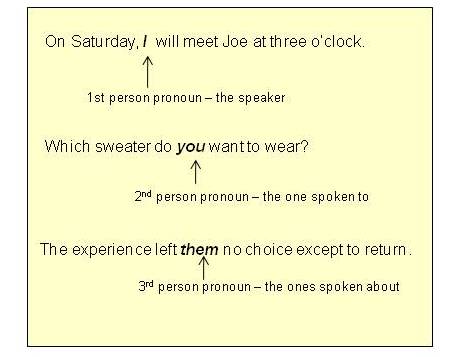
Personal pronouns have the following characteristics:
1. three persons (points of view)
1st person - the one(s) speaking (I me my mine we us our ours) 2nd person - the one(s) spoken to (you your yours) 3rd person - the one(s) spoken about (he him his she her hers it its they their theirs)
Examples
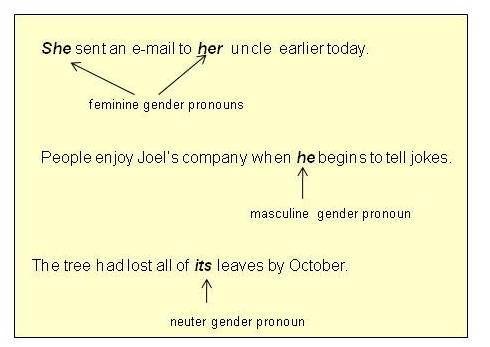
2. three genders
feminine (she her hers) masculine (he him his) neuter (it its they them their theirs)
Examples
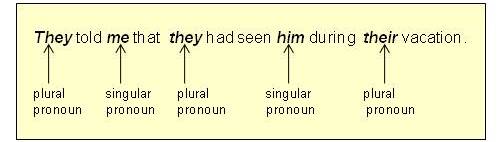
3. two numbers
singular (I me my mine you your yours he him his she her hers it its) plural (we us our ours you your yours they them their theirs)
Examples
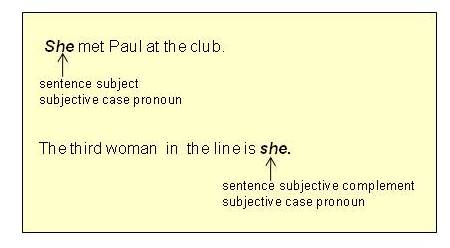
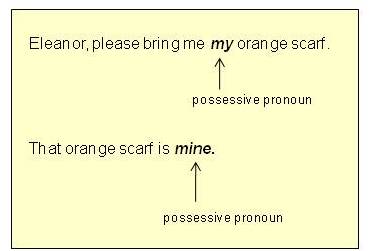
4. three cases
subjective (I you he she it we they) possessive (my mine your yours his her hers our ours their theirs) objective (me you him her it us them)
Examples - subjective case
Examples - possessive case
Examples - objective case NOTE: Because of pronoun case, the pronoun's form changes with its function in the sentence. Follow this link to pronoun case for more information.