Demonstrative pronouns can also be used as determiners.
|
Example:
|
Hand me that hammer. (that describes the noun hammer)
|
Demonstrative pronouns can also be used as qualifiers:
| |||||||||
Example:
| |||||||||
She wanted that much money? (that describes the adjective much)demonstrate (verb): to show; to indicate; to point to
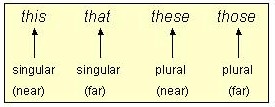
A demonstrative pronoun represents a thing or things:
Here are some examples with demonstrative pronouns, followed by an illustration:

Do not confuse demonstrative pronouns with demonstrative adjectives. They are identical, but a demonstrative pronoun stands alone, while a demonstrative adjective qualifies a noun.
Normally we use demonstrative pronouns for things only. But we can use them for people when the person is identified. Look at these examples:
|
C. Reflexive / Intensive Pronouns : the "self" pronouns
reflexive (adj.) [grammar]: reflecting back on the subject, like a mirror
We use a reflexive pronoun when we want to refer back to the subject of the sentence or clause. Reflexive pronouns end in "-self" (singular) or "-selves" (plural).
There are eight reflexive pronouns:
| reflexive pronoun | |
|---|---|
| singular | myself yourself himself, herself, itself |
| plural | ourselves yourselves themselves |
Look at these examples:
| non-reflexive the underlined words are NOT the same person/thing | REFLEXIVE pronouns the underlined words are the SAME person/thing |
|---|---|
| John saw me. | I saw myself in the mirror. |
| Why does he blame you? | Why do you blame yourself? |
| David sent him a copy. | John sent himself a copy. |
| David sent her a copy. | Mary sent herself a copy. |
| My dog hurt the cat. | My dog hurt itself. |
| We blame you. | We blame ourselves. |
| Can you help my children? | Can you help yourselves? |
| They cannot look after the babies. | They cannot look after themselves. |
Intensive pronouns
Notice that all the above reflexive pronouns can also act as intensive pronouns, but the function and usage are different. An intensive pronoun emphasizes its antecedent. Look at these examples:
- I made it myself. OR I myself made it.
- Have you yourself seen it? OR Have you seen it yourself?
- The President himself promised to stop the war.
- She spoke to me herself. OR She herself spoke to me.
- The exam itself wasn't difficult, but the exam room was horrible.
- Never mind. We'll do it ourselves.
- You yourselves asked us to do it.
- They recommend this book even though they themselves had never read it. OR They recommend this book even though they had never read it themselves.
These pronouns can be used only to reflect or intensify a word already there in the sentence.
Reflexive / intensive pronouns CANNOT REPLACE personal pronouns.
Examples:
|
I saw myself in the mirror. (Myself is a reflexive pronoun, reflecting the pronoun I.)
|
I’ll do it myself. (Myself is an intensive pronoun, intensifying the pronoun I.)
|
Note: The following words are substandard and should not be used:
theirselves theirself hisself ourself

No hay comentarios.:
Publicar un comentario